 EN



The Manufacturing Challenges of Miniature Metal Fasteners
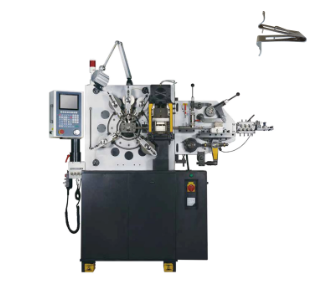
In the fast-moving world of modern hardware manufacturing, producing miniature metal components such as apparel hooks, strap adjusters, and small fastening buckles requires an extraordinary level of dimensional accuracy. Historically, fabricating these small accessories demanded a fragmented, multi-stage production workflow involving separate wire straightening, blanking, manual transfer presses, and secondary welding or assembly steps. This traditional approach frequently led to high defect rates, excessive material handling, and extended cycle times that frustrated plant managers. Today, however, engineering advancements have transformed the landscape entirely. A modern, high-precision buckle making machine can indeed complete the entire manufacturing cycle of small buckles in a single continuous, automated step, satisfying the rigorous demands of modern mass-production environments without compromising structural integrity or surface finish.
Technical Foundations Enabling Single-Step Forming
Achieving flawless single-step forming for miniature fasteners relies on a sophisticated integration of mechanical kinematics and computer-controlled motion. Advanced industrial buckle making machines combine synchronized wire or strip feed mechanisms with high-speed cam-driven or AC servo-driven slide stations. According to precision metal-forming engineering guidelines, integrating multi-axis slide movements allows the machine to perform simultaneous feeding, straightening, bending, piercing, and cut-off actions within a single tool zone. The stock material is fed into the tooling area where vertical and horizontal forming slides shape the wire or metal ribbon around custom-designed mandrels smoothly. This eliminates intermediate part transfers, ensuring that tight dimensional tolerances are preserved throughout every production cycle without cumulative alignment errors.
Real-World Engineering Case Study: Streamlining Garment Hardware Production
Drawing from hands-on shop-floor commissioning experience in industrial fastener manufacturing facilities, consider a mid-sized hardware supplier struggling with high scrap rates and bottlenecks when producing small brass and steel strap buckles. The legacy setup required separate stamping presses and manual assembly jigs, creating severe production delays and inflated labor costs. By replacing the outdated lines with an advanced, automated buckle making machine featuring integrated slide forming units and quick-change tooling, the facility revolutionized its output. Raw wire entered one end, and completely closed, stress-relieved, perfectly dimensioned buckles emerged from the other end at speeds exceeding hundreds of pieces per minute. This real-world transition proved conclusively that single-step forming eliminates intermediate handling bottlenecks while drastically improving product consistency.
Economic & Commercial Value: Maximizing Throughput and ROI
The commercial rationale for investing in a dedicated, high-speed buckle making machine extends far beyond immediate technical convenience; it drives profound operational efficiency and long-term financial profitability. For factory owners and production managers, consolidating a multi-step manufacturing process into a single machine dramatically reduces capital expenditure on auxiliary equipment and floor space. Furthermore, automated single-step production significantly cuts down labor overhead by eliminating manual tending between operations, while minimizing scrap rates through precise material utilization. These operational gains translate directly into shorter lead times, enhanced ability to fulfill high-volume custom orders profitably, and an accelerated return on investment in fiercely competitive global supply chains.
Navigating Technical Challenges: Material Limits, Tooling, and Maintenance
While modern buckle making machines deliver remarkable efficiency, engineering transparency requires acknowledging the operational parameters and maintenance disciplines necessary for optimal performance. Small buckles are often fabricated from diverse materials, including stainless steel, spring brass, and carbon steel, each exhibiting unique tensile strengths and springback behaviors. Operators must calibrate feed lengths and cam timing precisely to compensate for material variance. Additionally, maintaining high-speed operational reliability requires utilizing premium wear-resistant tool steels, maintaining proper lubrication schedules, and executing routine preventive maintenance on feed rollers and forming pins. By coupling advanced machine capabilities with disciplined shop-floor practices, manufacturers can consistently achieve high-yield, defect-free production runs over millions of continuous cycles.
Empowering Precision Manufacturing with Xinsheng
Unlocking the full potential of high-speed, single-step buckle manufacturing requires much more than just advanced machinery; it demands a trusted industrial partner capable of delivering robust engineering, customized tooling solutions, and dependable global supply chain support. Xinsheng has earned a sterling reputation as a prominent industry leader in specialized wire and strip forming technology, combining decades of intensive research, development, and stringent quality control. The comprehensive lineup of buckle making machines engineered by Xinsheng is meticulously designed to handle diverse wire diameters, complex miniature geometries, and demanding production schedules with unwavering precision and durability. Backed by expert technical consultation, comprehensive operator training, global logistics, and responsive after-sales service, Xinsheng empowers manufacturers worldwide to optimize their production efficiency, reduce operational costs, and scale their businesses with absolute confidence.
Table of Contents
- The Manufacturing Challenges of Miniature Metal Fasteners
- Technical Foundations Enabling Single-Step Forming
- Real-World Engineering Case Study: Streamlining Garment Hardware Production
- Economic & Commercial Value: Maximizing Throughput and ROI
- Navigating Technical Challenges: Material Limits, Tooling, and Maintenance
- Empowering Precision Manufacturing with Xinsheng